

CJC-1295 and Ipamorelin: Sleep and Recovery Stack
What to Know About the CJC-1295 and Ipamorelin Stack
If you've been researching peptides for better sleep or faster recovery, the CJC-1295 and Ipamorelin pairing keeps popping up, often wrapped in bold promises and very little context. This guide explains what the stack is, how it's thought to act in the body, and what people actually report, so you can walk into a conversation with a provider already knowing the right questions to ask.
What Is the CJC-1295 and Ipamorelin Peptide Stack?
The CJC-1295 and Ipamorelin stack combines two peptides that act on separate growth hormone signaling pathways, and is explored by some users for potential effects on sleep quality, recovery, and body composition. Peptides are short chains of amino acids that act as signaling molecules in the body.
CJC-1295 is a synthetic analog of growth hormone-releasing hormone, or GHRH. Ipamorelin belongs to a separate group called growth hormone secretagogues, which mimic ghrelin's action at the pituitary gland. On their own, each one nudges the body's own growth hormone signaling. Paired together, they're thought to act on two different pathways simultaneously, which is the rationale practitioners give for using them together rather than alone.
The distinction matters in practice. A GHRH analog like CJC-1295 works upstream, telling the pituitary to keep producing its own growth hormone, while a secretagogue like Ipamorelin acts more like a trigger for release. Because both rely on the body's existing machinery, they depend on a pituitary that can still respond, which is one reason results tend to differ by age and individual physiology.
How Does the Growth Hormone Peptide Stack Work in the Body?
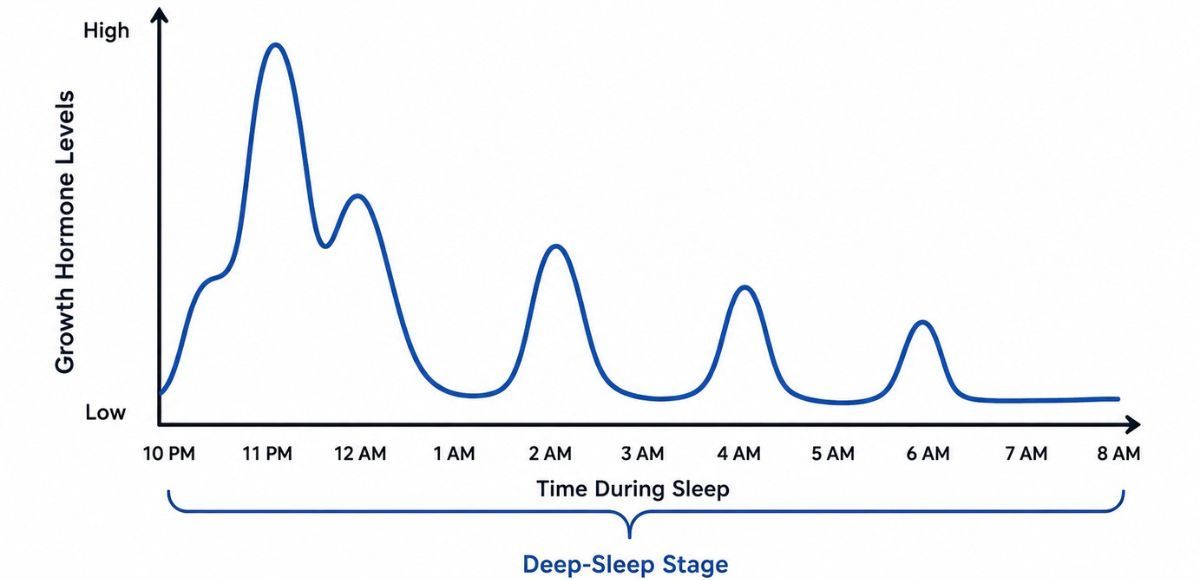
Your body releases growth hormone in pulses, mostly during deep sleep. That release is governed by signals from the hypothalamus and pituitary gland, and it naturally declines with age.
CJC-1295 is thought to extend the signal that tells the pituitary to release growth hormone. Ipamorelin is thought to trigger a cleaner, more selective pulse without the appetite spikes or cortisol changes linked to some older secretagogues. The theory behind combining them is simple: one lengthens the signal while the other sharpens the pulse.
The pulse pattern is part of what makes this matter. The body is built to release growth hormone in bursts rather than a constant stream, and that rhythm shapes how downstream signals like IGF-1 behave. The case for a paired protocol is that it may nudge this natural pattern rather than flatten it, which is also why timing doses around sleep comes up so often in practitioner discussions.
Early pharmacology work published in the
Journal of Clinical Endocrinology and Metabolism documented prolonged growth hormone and IGF-1 release from CJC-1295 in healthy adults, and selective action was the focus of the
original research describing Ipamorelin. Those findings describe biological mechanisms, not guaranteed outcomes for any one person.
What Users Report About Peptides for Sleep and Recovery
The two effects people mention most often when discussing
peptide therapy for sleep and recovery are deeper sleep and a quicker rebound after hard training. Because natural growth hormone release peaks during deep sleep, sleep quality is usually the change users notice first.
Reported experiences commonly include:
- Falling asleep more easily and waking less during the night
- Feeling more rested on the same number of hours
- Less soreness in the day or two after intense exercise
- A sense of recovering faster between workouts
These are self-reported patterns, not promised results. Sleep and recovery are shaped by training load, stress, age, and dozens of other variables, so two people on the same protocol may describe very different experiences.
A Look at Ipamorelin Body Composition Changes
Body composition is the third reason this pairing gets attention, and it's where expectations need the most tempering. Any changes users describe tend to be gradual and modest, and they show up alongside consistent training and nutrition.
When people talk about ipamorelin and body composition changes, they usually describe a gradual shift over months rather than weeks: slightly easier maintenance of lean mass, modest changes in how the body stores fat, and better workout performance that indirectly affects shape. None of that is a weight-loss mechanism on its own. If fat loss is your actual goal, it's worth understanding whether peptides for weight loss really work before you build a plan around them.
Considerations Before Starting the Stack
This is the part that marketing usually skips. Neither peptide is approved by the FDA as a finished prescription drug for general wellness use. The legal landscape for compounding them has shifted before and is shifting again: both were restricted from compounding pharmacies in 2023, and regulators are now reviewing whether to ease some of those restrictions, though the process is ongoing and the outcome isn't settled.
Confirm current sourcing legality directly with your provider and pharmacy rather than assuming routine availability, and be cautious about anything sold without provider oversight, since product quality outside that oversight varies widely.
A few things worth weighing first:
- Sourcing and purity: Unregulated peptides can be mislabeled or contaminated. Where a product comes from matters as much as the protocol.
- Reported side effects: Users sometimes mention water retention, tingling, headache, or irritation at the injection site. Individual responses differ.
- Your health history: Existing conditions, medications, and labs all change the calculus, which is why self-prescribing is risky.
- Malignancy history: Growth hormone secretagogues may not be appropriate for individuals with a history of active malignancy, as growth hormone stimulation could theoretically promote tumor growth.
- Metabolic factors: These peptides can raise IGF-1 and may affect insulin sensitivity and glucose regulation, which is particularly relevant for anyone who is prediabetic or has metabolic syndrome. This is worth discussing with your provider before starting.
- Honest goals: If stress is disrupting your sleep or your training lacks structure, a peptide is unlikely to be the missing piece.
Dosing and cycling are just as individual. Protocols differ in how long they run, how often they pause, and what is reasonable for one person may be wrong for another, depending on labs, age, and goals. Treating a number you found online as a fixed rule is exactly the kind of shortcut that gets people into trouble.
A whole-person, root-cause approach looks at those underlying factors first. That's the lens a functional medicine evaluation brings to questions like fatigue, recovery, and energy before any peptide enters the conversation.
Working With a Provider in Denver
Talk with a Balanced Healthcare provider about your sleep, recovery, and body composition goals, and find out whether a peptide protocol belongs in your plan. Talk with Cora Mattie, PA-C at Balanced Healthcare, about your sleep, recovery, and body composition goals. See how the
direct primary care membership gives you the time and access to explore it properly.
Frequently Asked Questions
1. What is CJC-1295 and Ipamorelin used for?
People typically explore this combination for sleep quality, post-exercise recovery, and gradual body composition goals. It interacts with the body's own growth hormone signaling rather than introducing synthetic growth hormone. None of these uses guarantees outcomes, and a provider should guide any decision.
2. How does the CJC-1295 and Ipamorelin stack work?
CJC-1295 is thought to lengthen the signal that prompts growth hormone release, while Ipamorelin is thought to trigger a more selective pulse. Combined, the idea is that they act on two pathways at once. The body still controls the actual release, mostly during deep sleep.
3. What do users report about this peptide stack?
The most common self-reported changes are deeper sleep and faster recovery between workouts, with body composition shifts described as slow and modest. These reports vary widely from person to person and are shaped by training, stress, and overall health.
4. Is this peptide stack safe?
These peptides are not FDA-approved finished drugs for general wellness, and the legal status of compounding them is still evolving in 2026, so safety depends heavily on sourcing and provider oversight. Reported side effects include water retention, tingling, and injection-site irritation. The risk picture differs for everyone, including those with metabolic conditions or a malignancy history, which is why provider supervision matters.
5. How long until results show?
Users who notice sleep changes often mention them within the first few weeks, while body composition changes are typically described over several months. Results are not guaranteed, and timelines depend on consistency, dosing, and individual factors that a provider can assess.
Key Takeaways
- Treat the pairing as a signal-modulating protocol, not synthetic growth hormone, and set expectations accordingly.
- Get sleep, training, and nutrition working first, since a peptide is unlikely to fix problems those create.
- Vet sourcing aggressively, because unregulated peptide quality is the single biggest safety variable.
- Bring your health history and current labs to any conversation, as they decide whether this is appropriate for you.
- Choose provider oversight over self-prescribing, so dosing and your response can be monitored over time.
This article is for educational purposes only and is not individual medical advice. Talk with your provider before starting any peptide therapy to discuss whether it's appropriate for your health